How SEMS decides
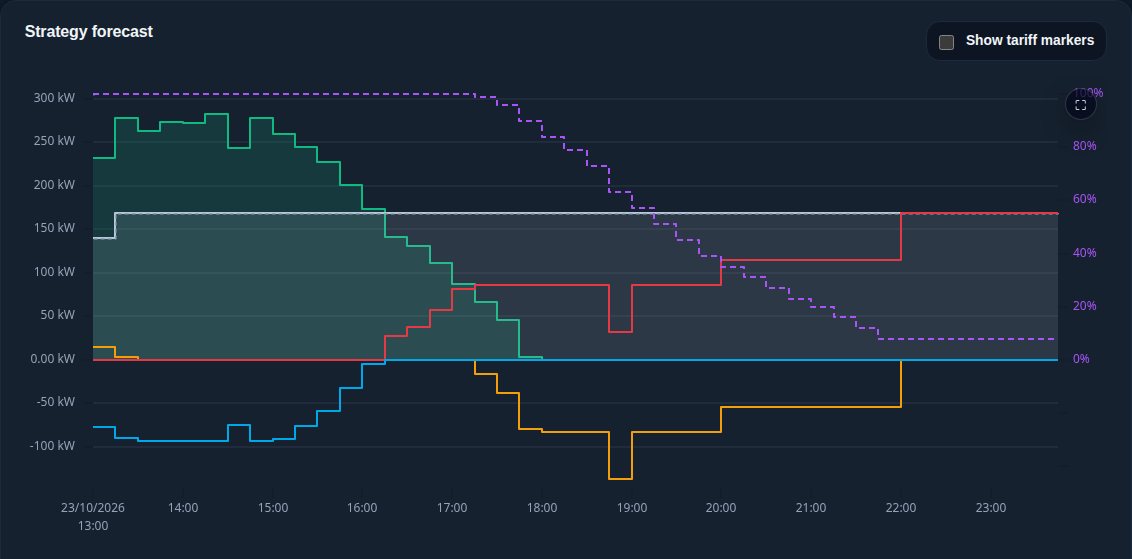
This page explains what SEMS takes into account, in which order, and where you can see the reason behind each decision.
The limits come first
SEMS never crosses the battery's charge levels and power limits, or the grid limits from your Electricity Plan: the contracted import and export power and, if entered, the agreed power for each time block. Where both grid limits apply, the lower one wins.
Then come your permissions in the Electricity Plan: Allow grid charging, Allow battery grid export and Allow grid-energy resale. If one is off, no strategy uses it, however good the price.
Then the money
Within those limits, SEMS values every option at your effective prices, with fees, network charges and battery losses included. A trade only happens when it still earns your Minimum net profit after those losses.
Your strategy decides which options are on the table: Self-Sufficiency never sells from the battery, while Trading looks for the best market opportunities.
Careful with tomorrow's sunshine
When SEMS sells stored energy expecting tomorrow's sun to refill the battery, it counts only the part of the solar forecast that has proven reliable on your site. A new site without that history counts none of it.
Steady decisions, quick corrections
SEMS fixes its decision for each quarter hour, so a new forecast cannot flip the battery back and forth, while the power still follows the live grid meter.
When something is missing
SEMS does not invent data. Without a price it plans no trades, a faulty battery is left out while the others carry on, and an EV charger that loses the grid meter reading drops to zero. Each case is reported on the Events page.
A limit is a ceiling, not a promise: if the load exceeds what the grid limit and the battery can cover, the limit is exceeded. SEMS warns you when the plan shows this coming and records it when it happens.
Seeing the reasons
The Strategy page shows the plan and a Decision log with the reason for each step in plain words, such as "Shaving peak", "Exporting for profit", "Hold (export unprofitable)" or "Curtail PV (export unprofitable)".